



Why Calendar Invites are the 3rd leg
1. Introduction: The Crisis of Attention
We have reached a state of “inbox insolvency.”
Email, once the gold standard for digital communication, has become a cluttered repository of unread notifications and marketing noise. SMS, while effective for immediate reminders, suffers from its own intrusive “noise” and provides little more than a temporary interruption.
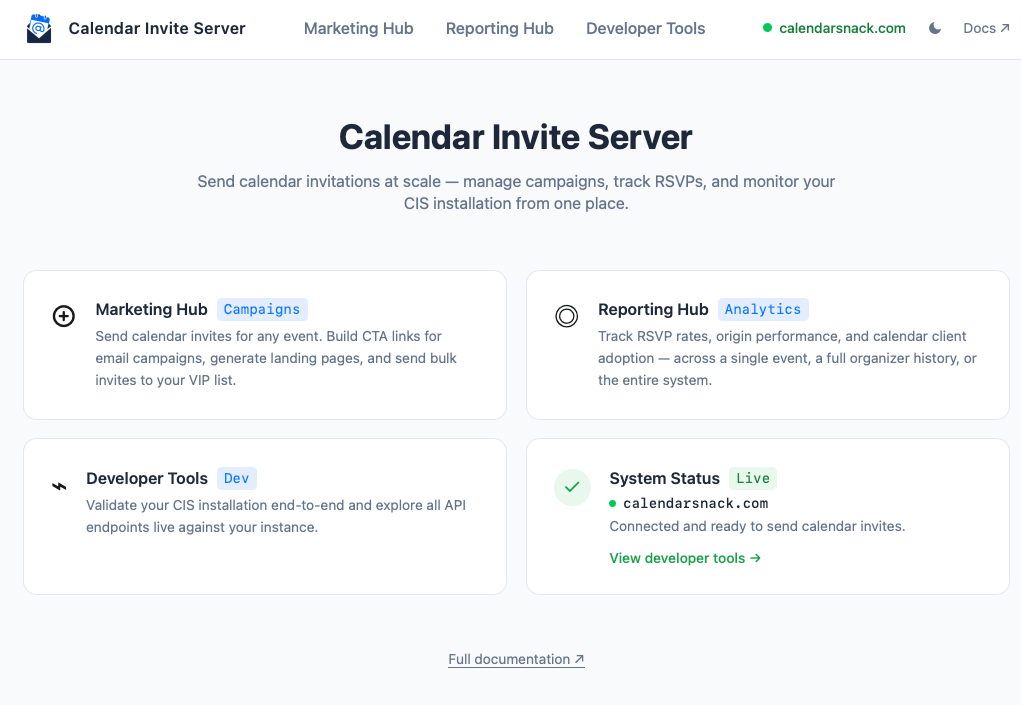
In the battle for the last mile of digital attention, brands are missing a critical strategic layer: the “Scheduling Gap.”
While the tech industry has spent a decade perfecting “scheduling”—the 1-on-1 discovery of a mutual time—it has largely ignored the challenge of distributing fixed events to an audience at scale.
The ability to place an event directly onto a participant’s schedule is not a utility; it is a communications superpower for AWS customers.
2. The “Third Channel” Strategy
To the modern communications architect, the Calendar Invite Server (CIS) is not just a tool; it is a dedicated third channel that operates with a different psychological mandate than its predecessors. To master this channel, one must understand the distinct protocol roles:
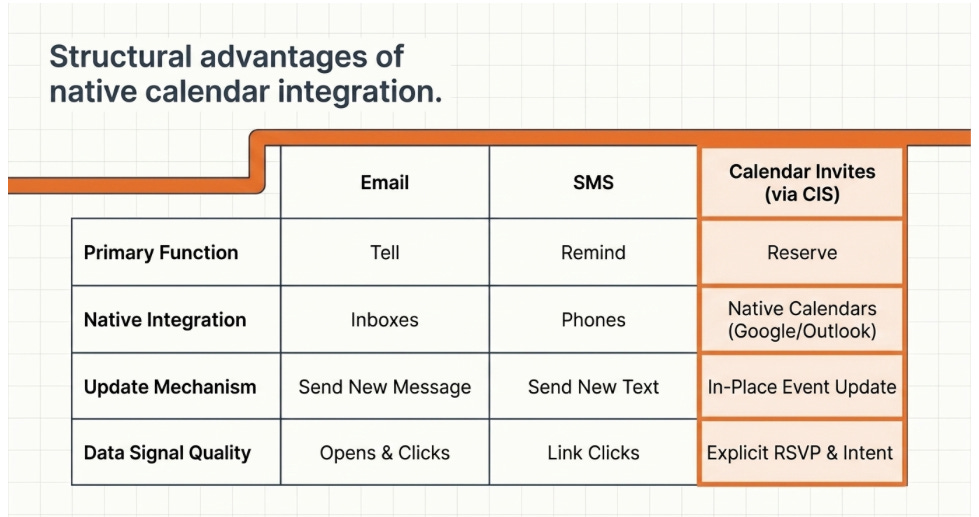
Email: The Informational Protocol (Telling).
SMS: The Tactical Protocol (Reminding).
Calendar Invites: The Commitment Protocol (Reserving Time).
Reserving time is a far more powerful trigger than merely sending a message. When an organization moves from “telling” a customer about an event to “reserving” space for it, they move from the periphery of an inbox to the center of a user’s daily life.
“Email tells people. SMS reminds people. Calendar invites reserve time.”
3. Data Sovereignty and the Intelligent Pipeline
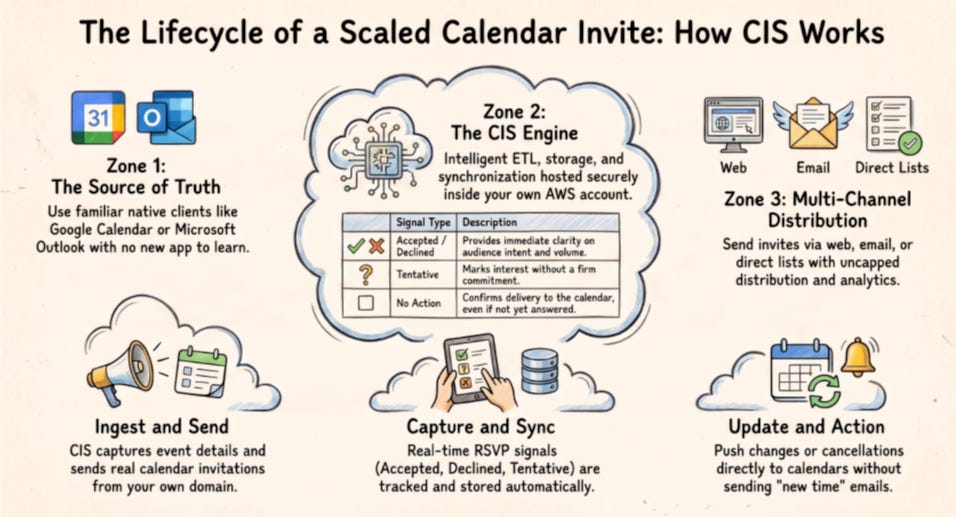
The strategic value of 31Events’ CIS lies in its architectural depth, specifically its Zone 2 for Intelligent ETL (Extract, Transform, Load) pipeline.
Unlike surface-level tools, CIS serves as a robust engine that ingests, normalizes, and synchronizes data from disparate providers, including Google and Microsoft Calendar Clients.
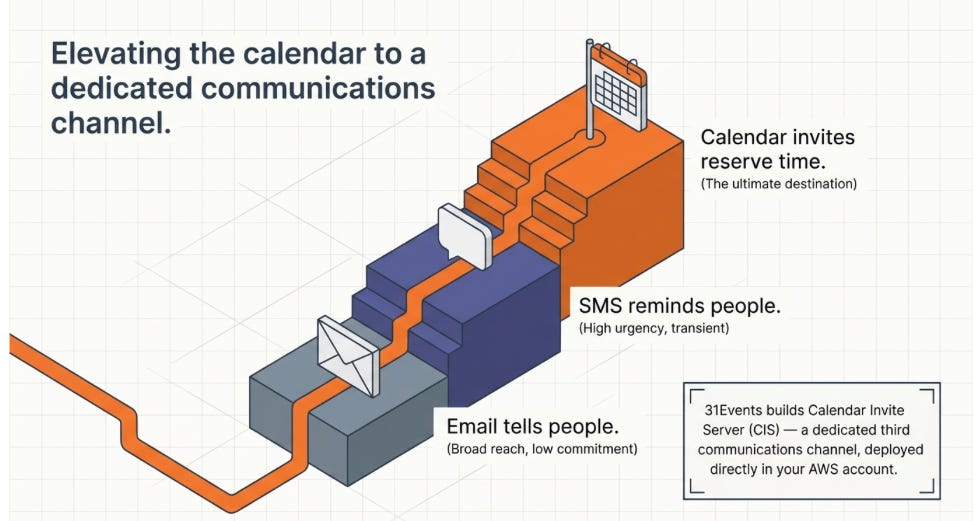
The Power of AWS-Native Deployment. Critically, for the enterprise, this server is deployed within the customer’s own AWS account. This isn’t just a technical detail; it is a matter of data sovereignty and security.
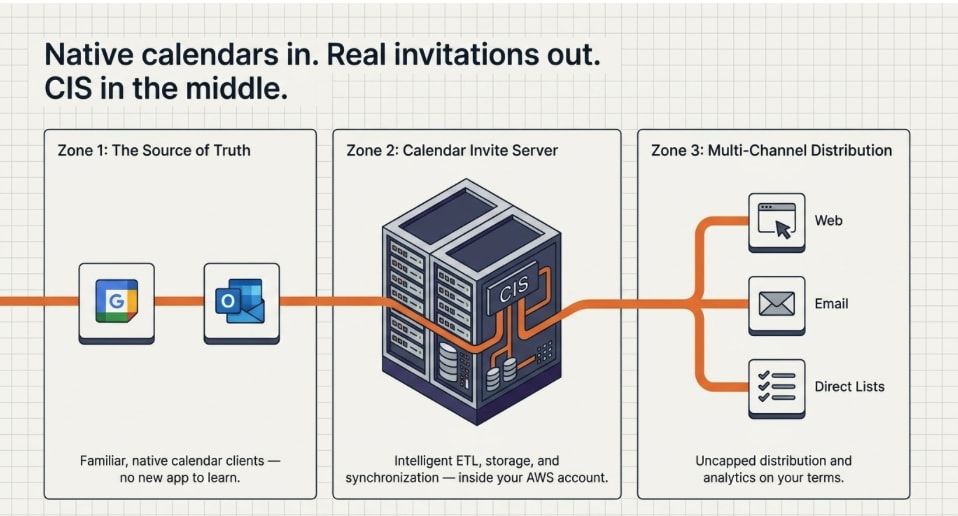
By keeping the communication pipeline within your own AWS environment using CIS, organizations maintain full ownership of their data and sender RSVP reputation, ensuring a level of trust that third-party “invitation sites” cannot match, using 3rd-party ADD-to-Calendar methods that either do not work or do not support your brand identity.
Exactly how the Calendar Client works with CIS
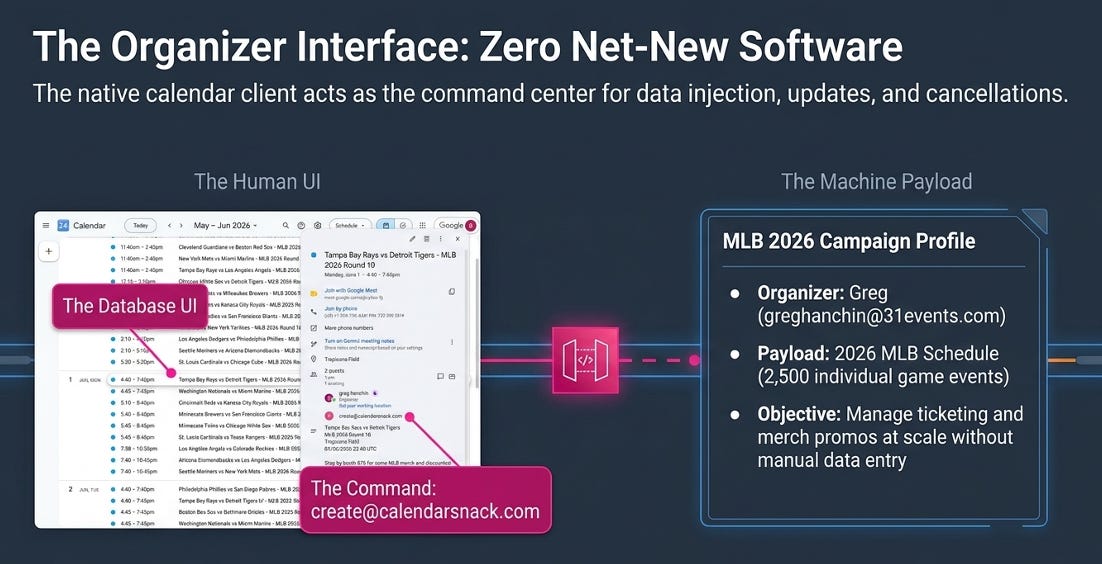
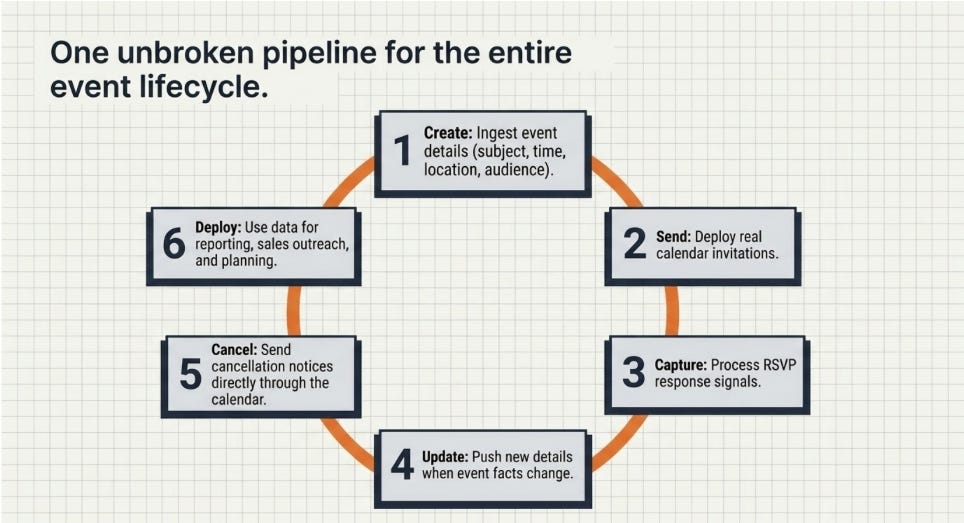
Organizers use their calendar client and copy the event to the CIS inbox for ingestion into their CIS account. This sets up the API codes and workflows for Email, Web, Apps, or Bulk sending of calendar invites using the CIS REST API.
4. Overcoming the “No Click” of Email Engagement
Traditional marketing is plagued by the “No Clicks”—the idea that if a user doesn’t click or open, the interaction has zero value.
CIS disrupts this by tracking four distinct response signals: Accepted, Declined, Tentative, and No action.
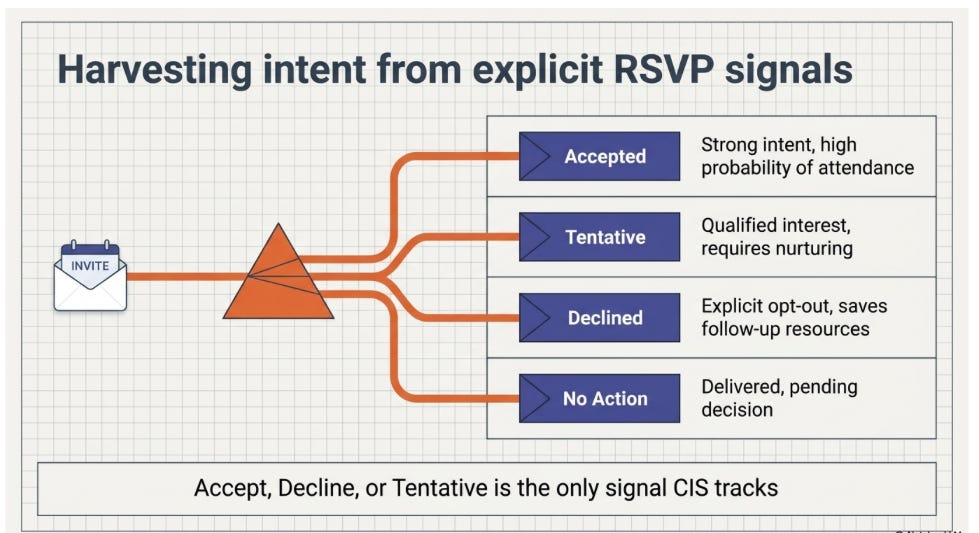
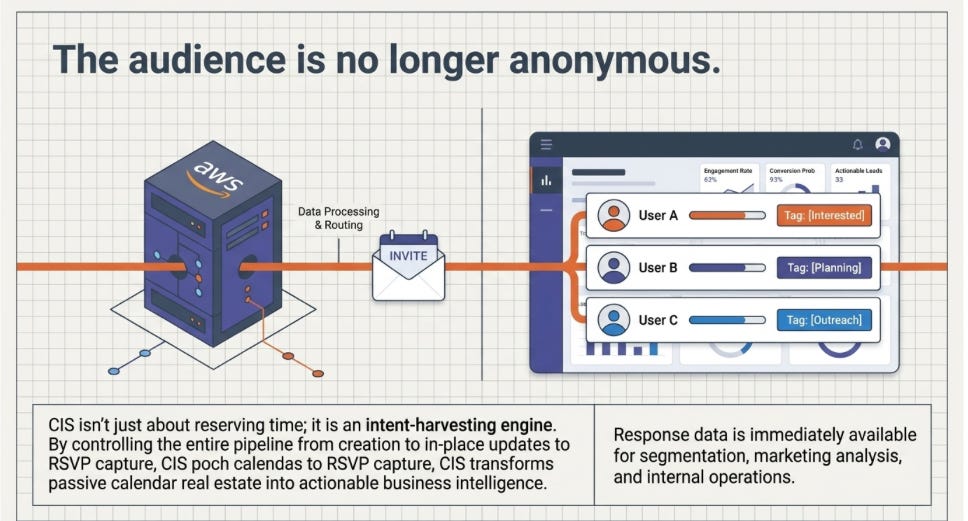
The Persistence of “No Action” In a CIS architecture, the “No action” status is a high-value signal.
While an email that goes unclicked eventually disappears below the fold, a calendar invite represents persistent real estate.
It remains visible at a specific date and time on the user’s device, pending a decision.
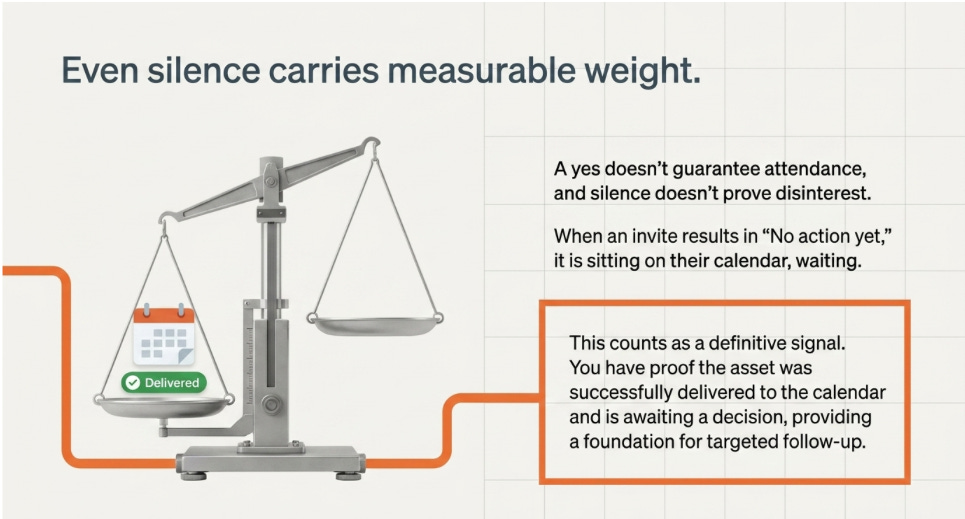
This status confirms that the invite was delivered and that the brand is now occupying a slot in the user’s mental model of their future. It ensures that the audience is never truly anonymous.
5. Host Authority and the “In-Place” Calendar Invite Update
The greatest friction in event management is the “update fatigue” caused by changing details. Traditionally, a change in venue or time triggers a “Please note the new time” email, adding to the noise and risking misalignment.
CIS introduces Host Authority. In this pipeline, the event facts belong exclusively to the host; invitees cannot suggest new times or alter locations.
This ensures a single source of truth.
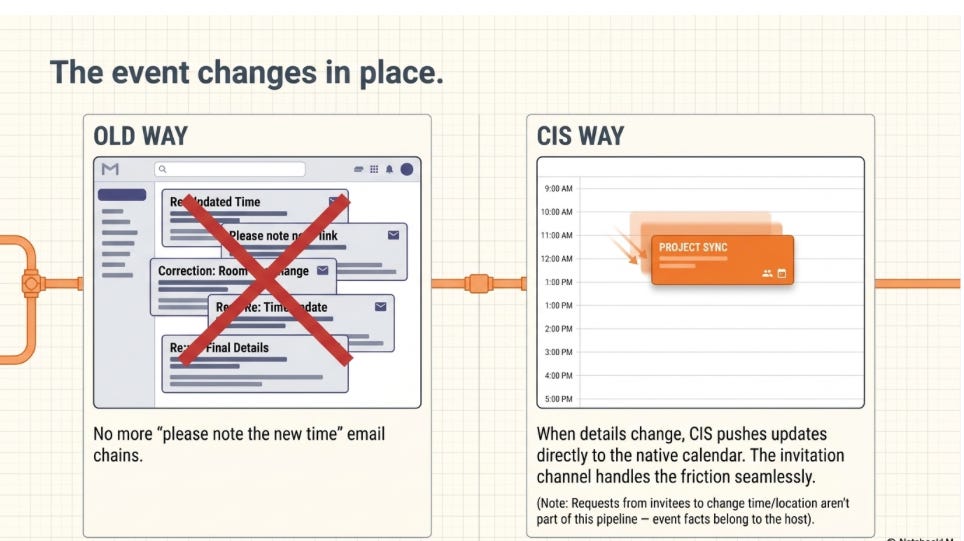
When details change, the server executes an “in-place” update. The event simply refreshes on the user’s calendar without a disruptive new notification.
It is a silent, respectful synchronization that prioritizes accuracy over inbox clutter.
6. Zero Friction: The Technology of Disappearance
The most impactful technology is often the one that disappears into the tools users already use. CIS leverages “Native Adoption” by operating within familiar environments:
Zone 1 (The Source): Organizers create events in their own native clients (Outlook/Google).
Zone 3 (The Edge): Invites are distributed via the web, email, or direct lists.
There is no new app to learn, no proprietary software to download, and no secondary login required.
By utilizing standard calendar protocols, CIS turns a global standard into a high-scale distribution network.
“Familiar, native calendar clients — no new app to learn.”
7. CIS Begins Where Scheduling Ends
We must distinguish between the discovery of time and the orchestration of an event. Scheduling is the 1-on-1 struggle to find a gap in a calendar. CIS is the strategic move that follows: once the time and subject are fixed, the server turns that entry into a professional invitation workflow that can be tracked and updated at scale. It is the transition from a personal note to a managed corporate asset.
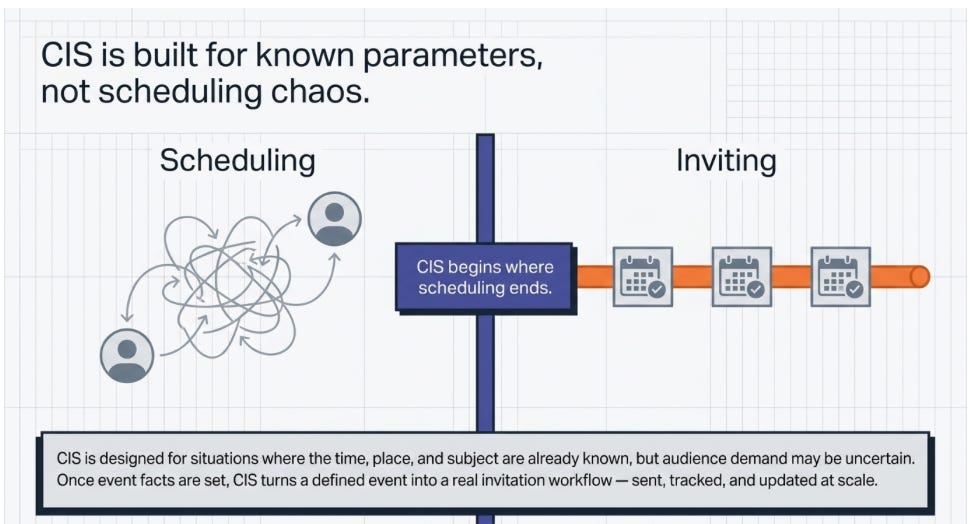
“CIS begins where scheduling ends. Once the event facts are set, it turns a defined event into a real invitation workflow.”
8. Conclusion: A Protocol for Intent
The calendar is the most valuable piece of digital real estate a person owns. By moving your communication strategy from the inbox to the schedule, you are transitioning from a relationship of “interruption” to a relationship of “intent.”
As you evaluate your digital presence, ask the hard strategic question: Is your brand a mere guest in a crowded inbox, or is it a permanent resident on the participant’s calendar?
See Calendar Invite Server at https://31events.com


