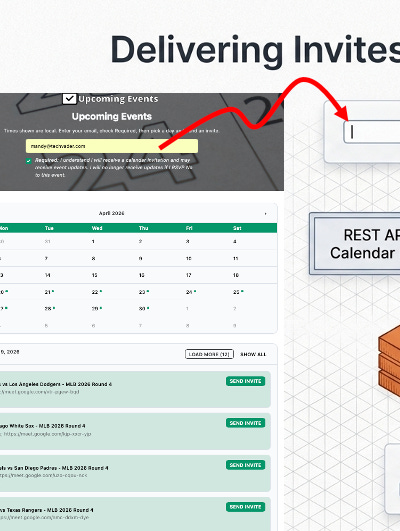

1. The Calendar Invite Server is built for AI Agents to run
We spend millions of dollars and countless engineering hours building custom dashboards and complex GUIs for CRUD data.
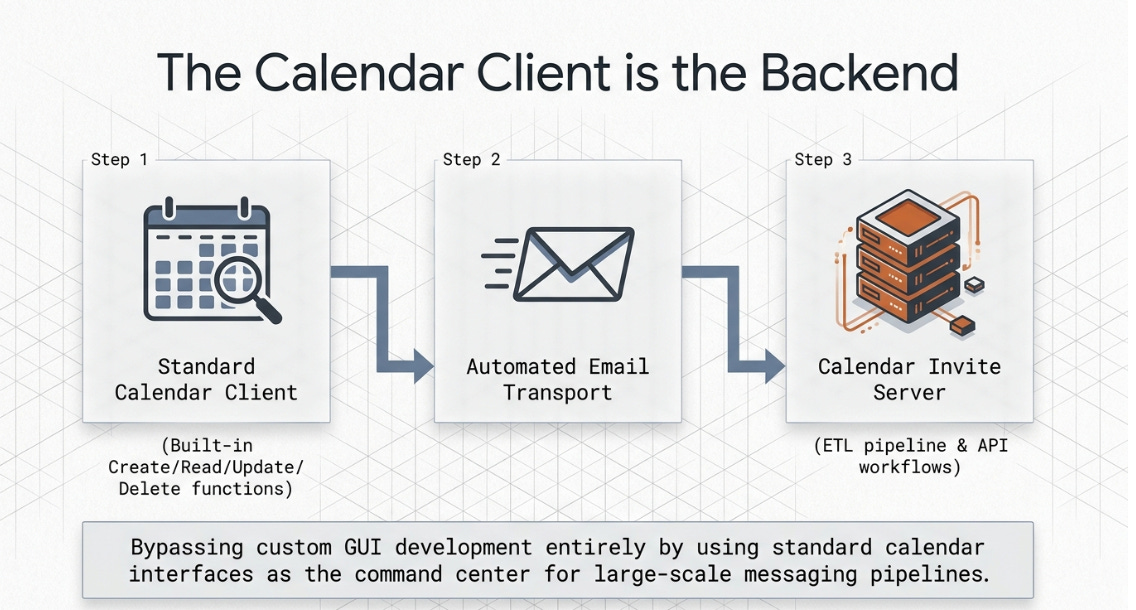
The “Calendar Invite Server” (CIS) flips this paradigm by using the Calendar Client for CRUD.
The Calendar Client is used to post data and set up a UID connection to the Calendar Invite Server REST API in AWS, which an AI Agent can operate on your behalf if you wish.
This serves as the runway for autonomous operations for event updates and promotional updates by Agentic Agents workflows.
Built as a serverless AWS messaging pipeline for calendar invites, the Calendar Invite Server turns the calendar clients we already use—Google and Microsoft—into highly scalable content management systems for any AWS organization that already runs AWS SES and the AWS serverless stack.
For AWS developers, the value is immediate: the entire Calendar Invite Server can be deployed in under an hour using CloudFormation and an AWS SES account.
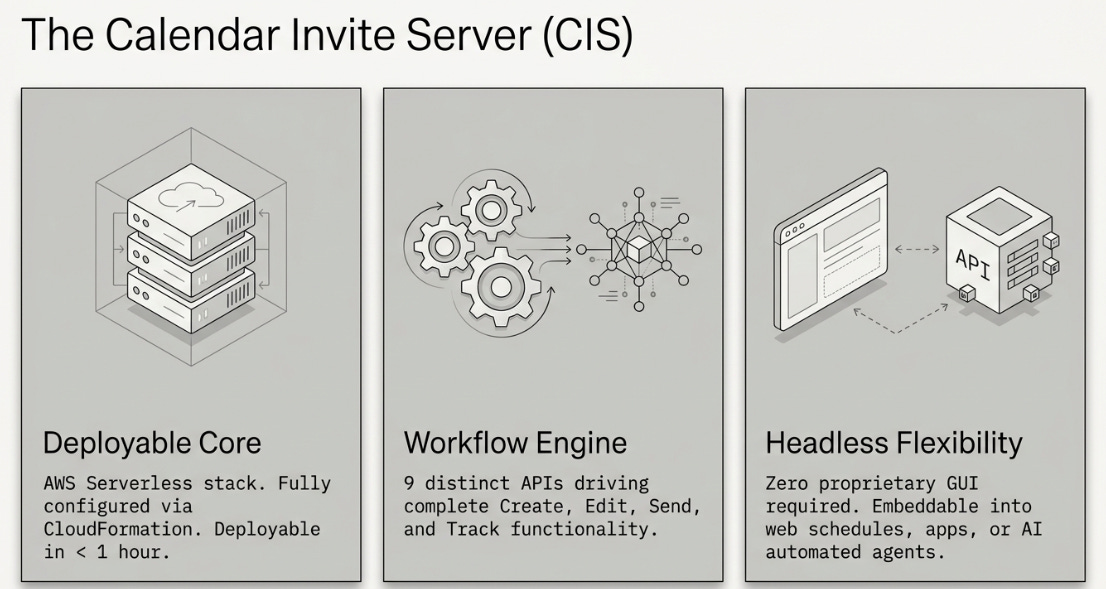
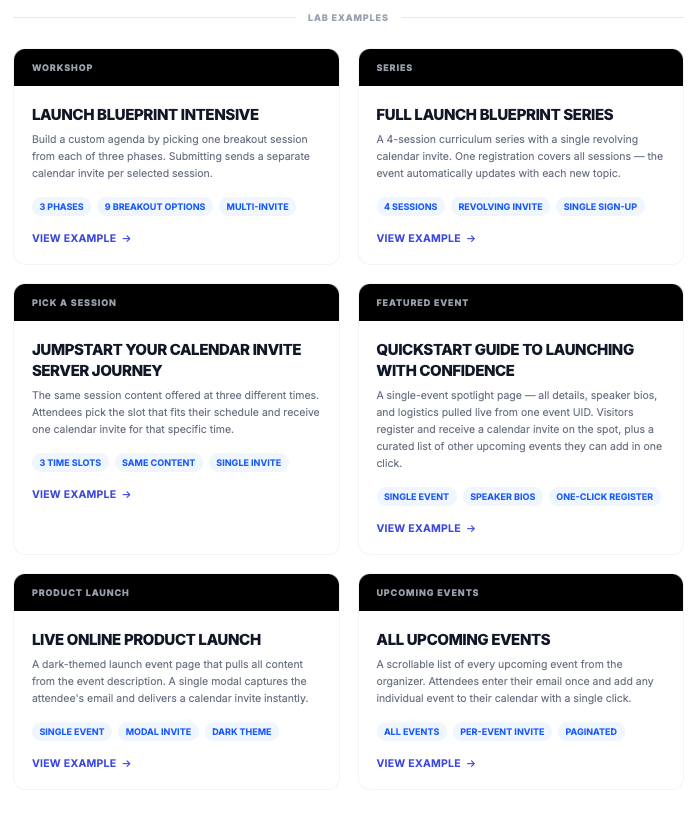
We include 20 Killer App Ideas, a Front-End for Organizer, and a Back-End Admin Server for Reporting.
Killer Apps for the Calendar Invite Server
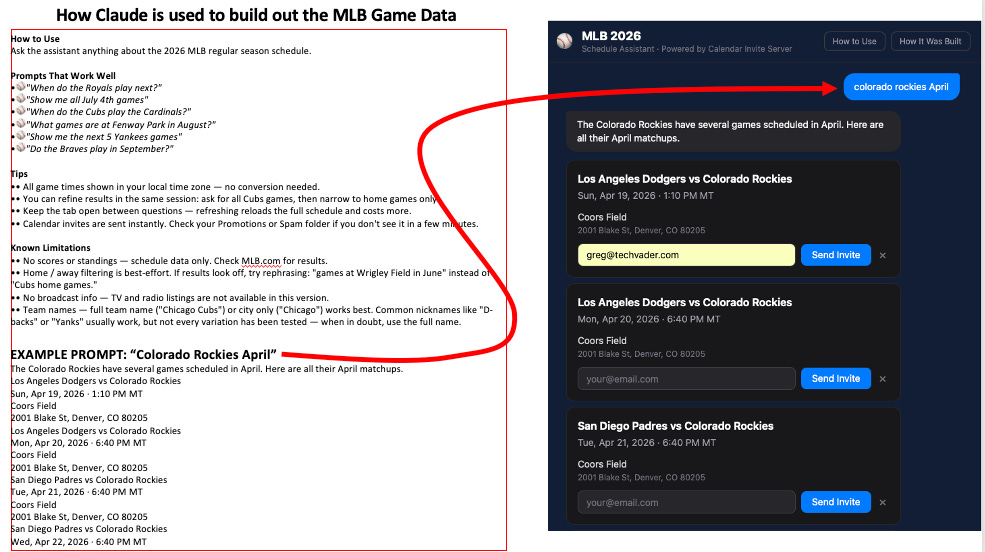
We also include our starter kit for using Claude to build custom game calendars, featuring one-click calendar invites with simple prompting.
Claude NLP for Sporting Search, Selection, and getting a Calendar Invite for a game
2. Takeaway 1: AI loves your Calendar Client as a CRUD Machine
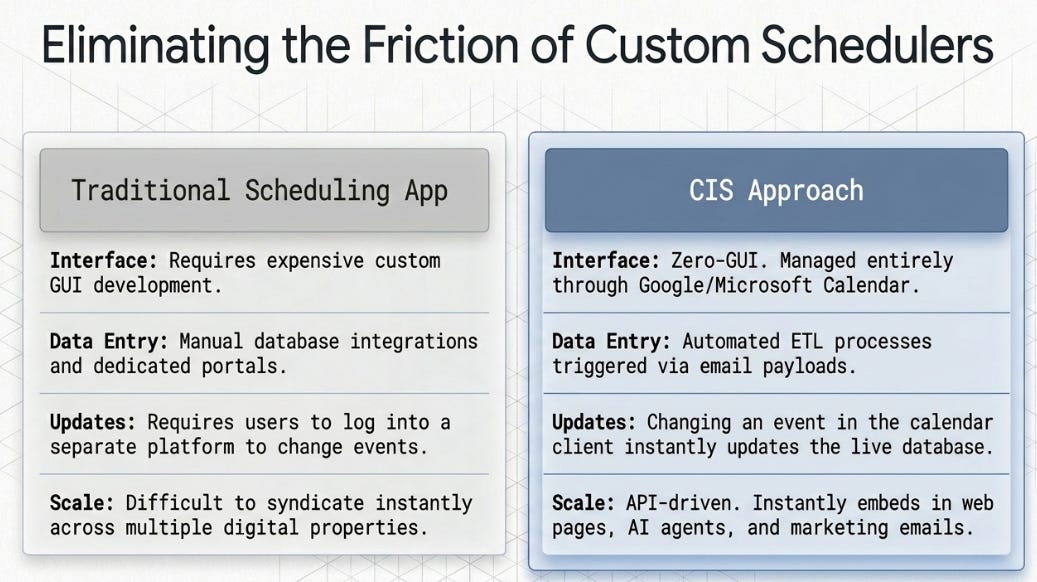
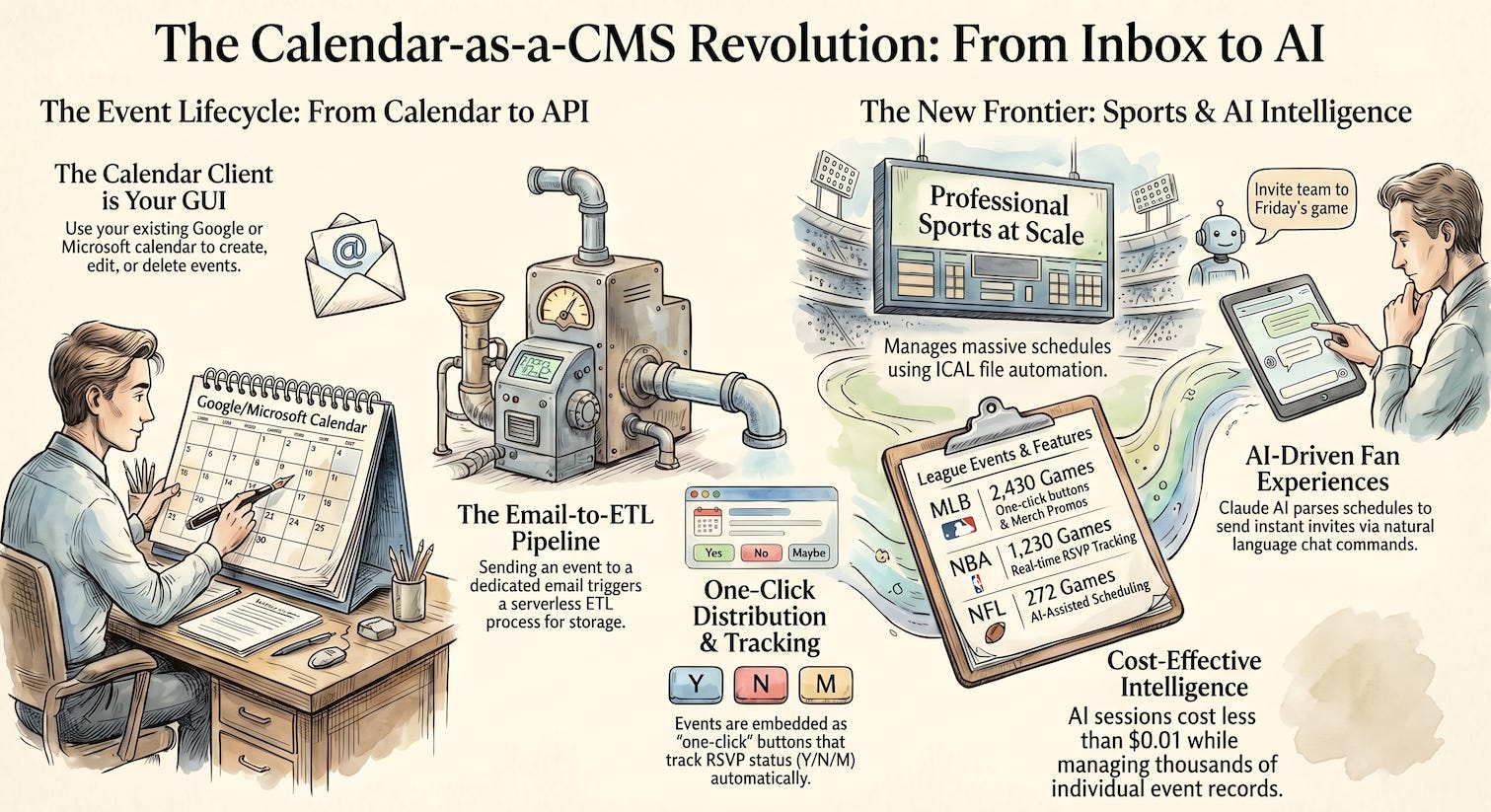
By using the calendar’s built-in CREATE, EDIT, and SAVE functions as a decoupled CRUD engine, the “UI tax” is effectively zeroed out. The calendar client handles authentication, user experience, and data entry.
When an organizer modifies a calendar event on their personal device using the calendar client, the data is updated on the calendar invite server using the UID.
This creates a sticky API pipeline for updating calendar invite messages for promotion use cases in this post for Sporting Events.
3. Takeaway 2: AI loves to talk API’s and Json
The CIS utilizes a technically elegant ETL (Extract, Transform, Load) pipeline triggered by a simple email address: create@YOURDOMAIN.com.
In technical terms, this address serves as an AWS SES Inbox API endpoint for dropping off calendar invite data from organizers.
When an event is sent to this address, the system processes the calendar invite data, assigns a Unique Identifier (UID), and stores the event details in a database.
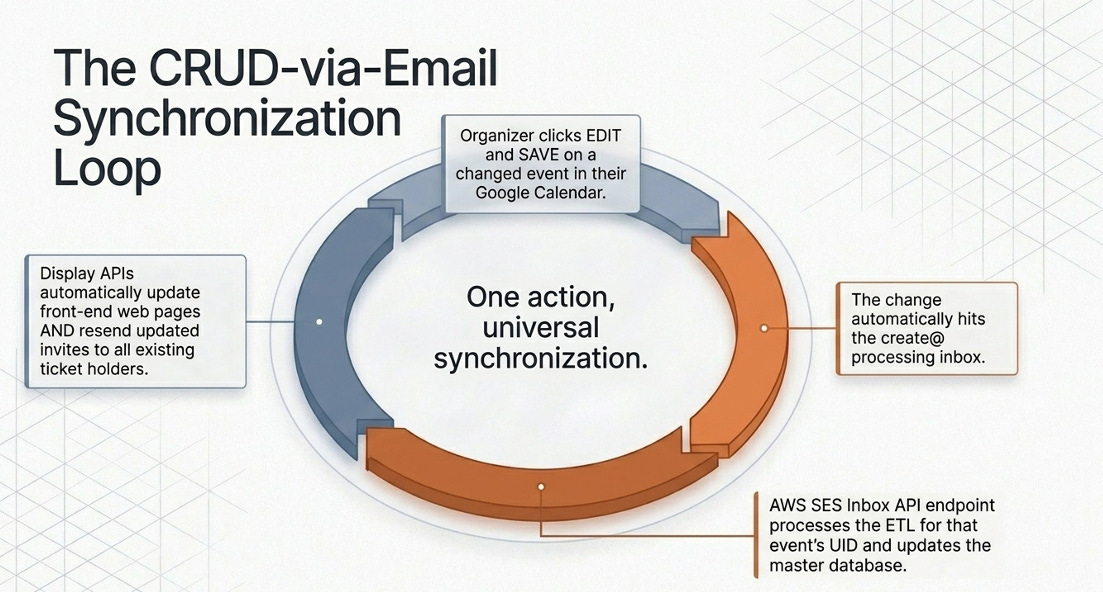
The true “secret” of this Content Management System, however, lies in the Update Loop.
Because the system is anchored to the UID, the EDIT and SAVE functions of the original calendar client trigger the ETL pipeline in real-time. Hit “Save” in Outlook, and the database updates instantly.
This democratizes integration; if you can send an invite, you can manage a high-scale scheduling API setting up for the Agentic AI workflows.
4. Takeaway 3: AI Agents are the New Personal Assistants
The architecture of the CIS is built for an era where AI agents, not just humans, manage our time.
By using IETF Calendar Invite artifacts, the system enables “virtual” calendar clients.
AI Browser Operators or automated time generators can operate on a user’s behalf, programmatically generating and updating invites using the same messaging pipeline.
This has profound implications for B2C marketing and consumer appointments.
In these ecosystems, an AI agent can bridge the gap between automated business logic and the human calendar, ensuring appointments are kept and schedules are synced without manual human intervention.
5. Takeaway 4: The Sporting Case Studies for MLB, NFL and NBA - Merch and Tickets
To understand the CIS's scalability, look at professional sports. Managing the logistics of an entire league’s season is traditionally a massive data task:
MLB: 2,430 games
NBA: 1,230 games
NFL: 272 games
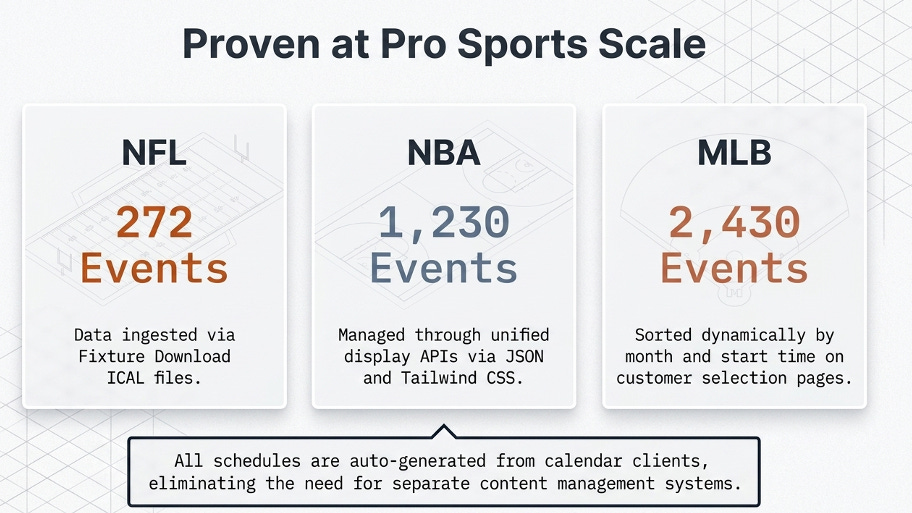
By uploading ICAL files to a calendar client and routing them through the create@ endpoint, these massive schedules are transformed into month-by-month web displays. Each game is paired with a “One-Click” invite button.
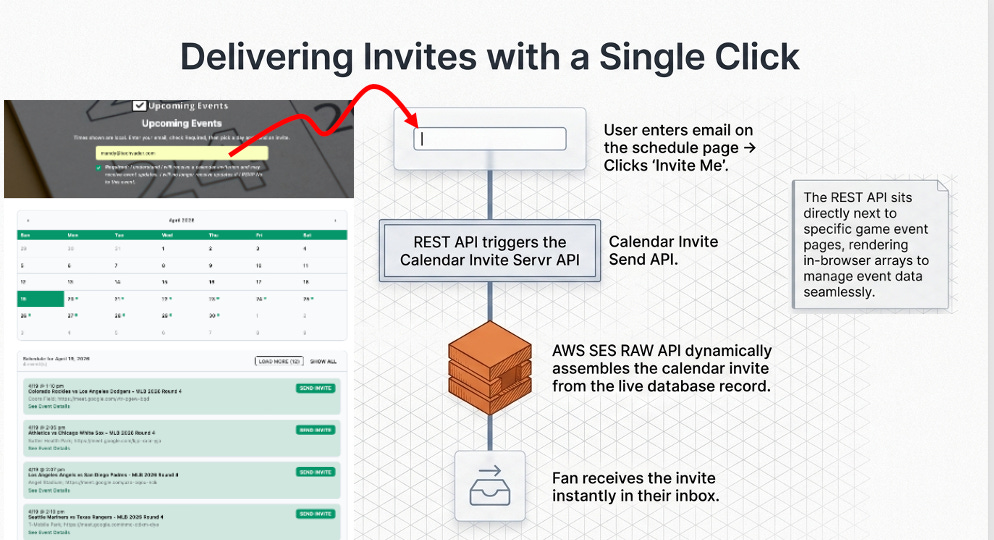
When a user enters their email, the system invokes the AWS SES RAW API to assemble and send a tracked calendar invite instantly.
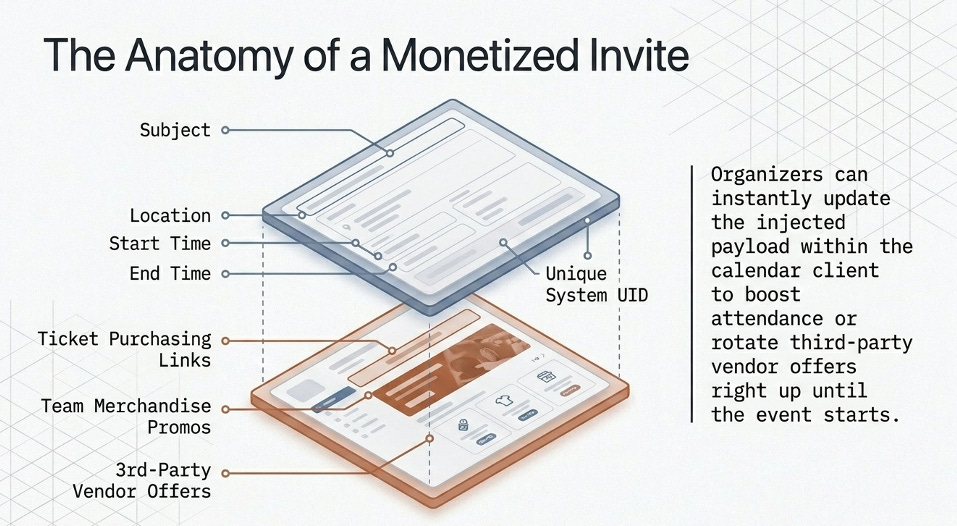
Furthermore, organizers can embed third-party promotions, merchandise links, or ticketing info directly within the invite message body, turning a simple notification into a direct marketing channel.
6. Takeaway 5: The AI-Driven Fan Experience
In a recent Phase 1 R&D experiment, the CIS infrastructure was used to power an AI fan experience for the MLB season.
Using Claude Haiku, the system compressed 1,833 games into a single text block.
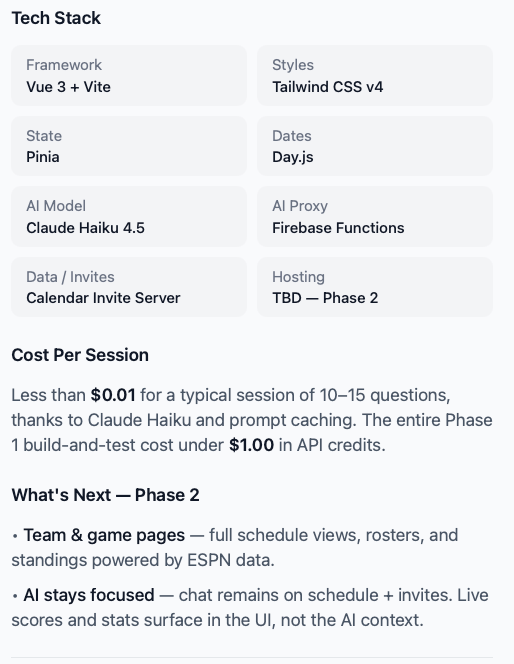
This app is a Phase 1 R&D experiment by 31Eventsdemonstrating how the Calendar Invite Server infrastructure can power an AI-driven fan experience — built in an afternoon, running on pennies per session.
The Architecture
INGEST Calendar Invite Server (CIS)
1,833 MLB games stored as calendar events under a single organizer. The existing REST API is the data source — no custom database needed.
Firebase Cloud Function
A secure proxy that compresses the schedule, injects it into the AI system prompt, and forwards the chat to Anthropic. Your API key never touches the browser.
AI
Claude Haiku (Anthropic)
Handles natural language queries against the schedule and returns structured JSON — game list, conversational text, and action type.
OUT
Calendar Invite Server (CIS) REST API for sending and tracking calendar invites.
When a fan requests an invite, the app fires a CIS Send API call. The invite lands in their inbox within seconds — no email infrastructure required.
How the AI Chat Works
• All 1,833 games are compressed into a single text block and sent to the AI on the first message of each session.
• The AI holds the full schedule in its context window — natural language queries replace dropdowns, filters, and search boxes.
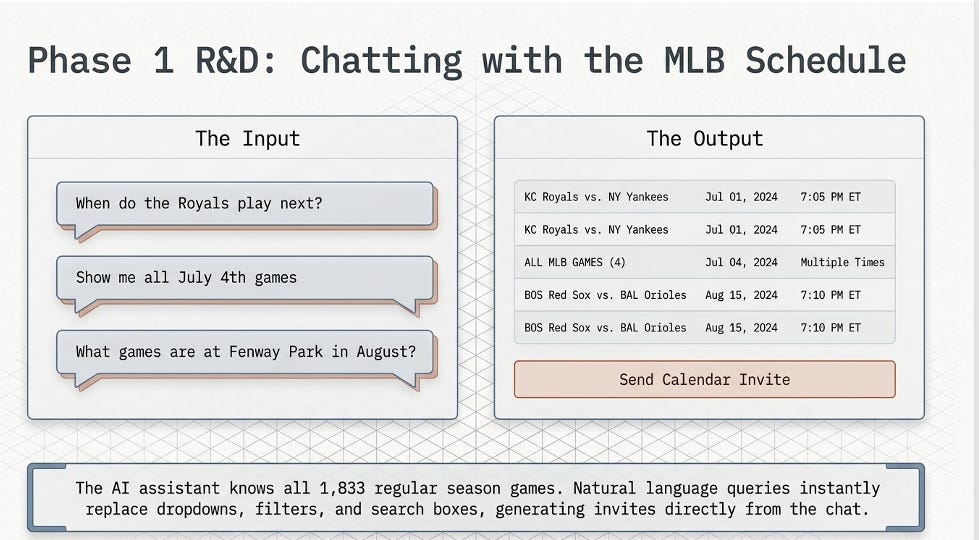
• Prompt caching means the schedule is only charged at full price once per session. Follow-up questions cost a fraction of a cent.
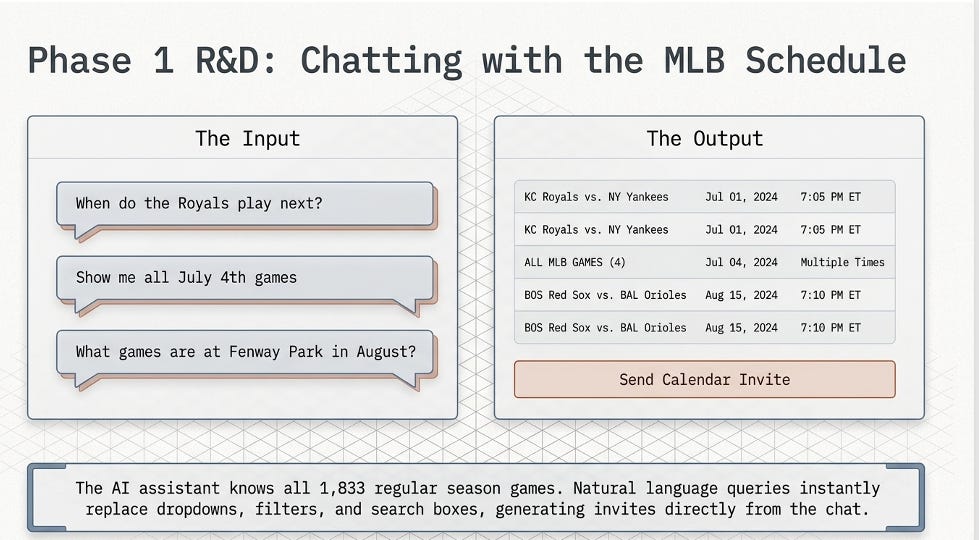
• The AI responds in a structured JSON contract — the app renders game cards directly from the response, no parsing guesswork.
7. RSVP Intelligence: Beyond the Sent Calendar Invite
The Calendar Invite Server provides enterprise-level reporting that goes far beyond simple “calendar invite sent” metrics.
By monitoring Y/N/M (Yes, No, Maybe) calendar receipts via an API Gateway, the system tracks every interaction in accordance with IETF collection guidelines.
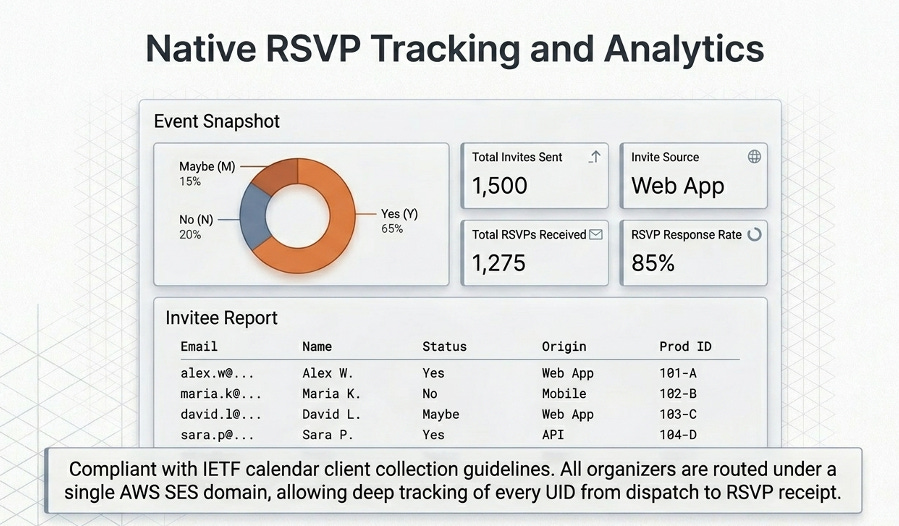
The Email Event Snapshots Report API provides data on status, origin, and Prod ID, the system also supports broad-scale reporting.
By collecting all organizers under a single AWS SES domain, the CIS can aggregate data to report on Total Invites Sent, Invite Source, and the overall RSVP Response Rate across the all organizers for the AWS SES domain used for the MX record.
8. Conclusion: AI will rule customer driven prompted Sporting Schedules
The convergence of serverless AWS stacks, IETF standards, and AI-driven logic is removing the “work” from “workflow.”
As we move toward a future of automated scheduling, the question for developers and strategists remains: Why build another dashboard when your calendar client is already the world’s most ubiquitous Content Management System for events?